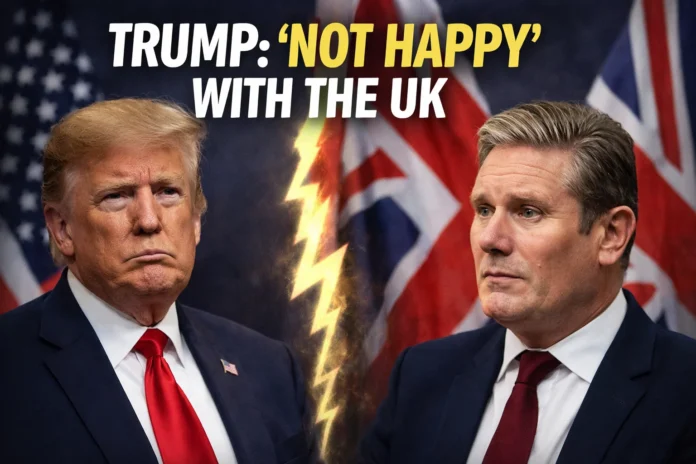


LONDON — US President Donald Trump has said he is “not happy” with the United Kingdom and criticised Prime Minister Keir Starmer, accusing him of relying too heavily on advisers during a growing diplomatic disagreement over the Middle East crisis.
The remarks come amid tensions between Washington and London over how allies should respond to escalating conflict in the region and threats to global shipping routes.
Trump Criticises UK Response
Speaking about the UK’s approach, Trump said he was surprised by the government’s stance and suggested Starmer should take a more decisive leadership role rather than depending heavily on advisers.
The US president also expressed frustration with Britain’s reluctance to commit additional military support to international efforts aimed at protecting shipping in the Strait of Hormuz, a vital global oil route.
Trump described the UK’s position as disappointing and argued that allies should do more to assist the United States in securing the strategic waterway.
Dispute Linked to Middle East Conflict
The disagreement between Washington and London is tied to the escalating conflict involving Iran and attacks on shipping in the Persian Gulf.
The United States has urged allies to contribute naval forces to help keep the Strait of Hormuz open, a route through which a significant portion of the world’s oil supply passes.
However, the UK government has been cautious about committing forces to a broader military operation, stressing the need for a coordinated international response rather than unilateral escalation.
Starmer Defends UK Position
Starmer has defended his government’s approach, saying the UK is working with international partners to develop a “viable collective plan” to restore safe navigation in the region.
The prime minister has also emphasised the importance of avoiding a wider regional conflict while protecting Britain’s economic and national security interests.
Several European allies, including Germany and Italy, have also been hesitant to commit naval forces, instead advocating diplomatic solutions and coordinated international action.
Rising Energy Concerns
The geopolitical tensions have already had economic consequences.
Disruptions in shipping and uncertainty around the Strait of Hormuz have contributed to rising global oil prices, raising concerns about inflation and energy costs across Europe.
In response, the UK government has announced financial support for households affected by higher heating oil costs, particularly in rural areas and Northern Ireland.
Strain on the “Special Relationship”
The latest comments highlight growing friction between the two leaders and raise questions about the future of the long-standing “special relationship” between the United States and the United Kingdom.
Despite the criticism, officials on both sides have indicated that cooperation between the two countries on security and defence issues will continue.